Let
me first tell you an
anecdote:
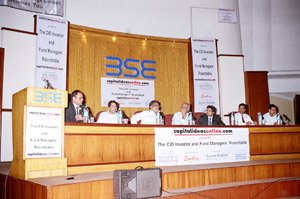
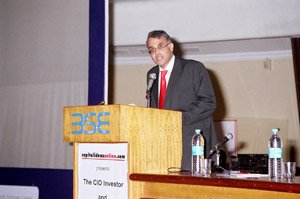
Chetan Parikh: Good evening Ladies and Gentlemen,
On behalf
of Capitalideasonline.com, I would like to thank
all of you for taking time out to be with us
this evening for the Annual CIO Investor and
Fund Managers’ Roundtable.
“In
the 1930s, out of power and financially
strapped, Churchill taught a lecture course at
The
class gasped.
Churchill, obviously relishing the
moment, pointed at a young woman in the tenth
row.
“What’s the answer?” he
demanded.
The
woman flushed and replied, “Well, obviously it’s
the male sexual organ.”
Wrong!”
said Churchill. “Who
knows the correct answer?”
Another
woman raised her hand. “The
right answer is that it’s the pupil of the human
eye, which expands to twelve times its normal
size when exposed to
darkness.”
“Of course!” exclaimed Churchill, and he turned back to the unfortunate first woman. “Young lady,” he said, “I have three things to say to you. First, you didn’t do the homework. Second, you have a dirty mind, and third, you are doomed to a life of excessive expectations.”
The
reason why I recounted that story is that the
key to successful investing is expectations and
you can make money and much more than 12 times
when your expectations differ materially from
those embedded in market prices and you are
right.
And
you increase your chances of being right when
you have an edge.
Bill
Miller, the market beating portfolio manager of
Legg Mason, wrote that there are three sources
of competitive advantages that an investor can
develop: informational, analytical or
behavioral.
Informational
is when you know something material that others
don’t. It is extremely difficult to get that
edge in large, well researched stocks unless you
act unethically on inside information. But small
and midcap stocks, which are outside the radar
of most brokerage houses, offer possibilities of
developing that edge.
Take
the second sort of edge: Analytical advantages
come from taking publicly available information
and processing and assessing it differently from
others. And finally, there is the behavioral
edge and there are ways to systematically
exploit human behavior in the financial markets.
I don’t want to go into prospect theory, support
theory, cognitive psychology and neuroscience
but behavioral finance and investor psychology
are as important as understanding financial
statements and valuation
metrics.
Capital
Ideas Online has promoted Capital Ideas Club.
You may be seeing the banners and pamphlets of
Capital Ideas Club and may well wonder why you
need a CIC when you have CCI in
Capital
Ideas Club is an exclusive investment community
where the best value investment ideas are
presented and reviewed by other expert
investors.
I
urge you to apply for membership because this
will be a great way to become a better investor
and analyst as your ideas will be shared in an
online forum with other expert value
investors.
Membership
is free, but will be limited to only a few
sophisticated investors who will join based on
the quality of their investment idea. Just 200
members will qualify for the
Club.
The
admission will be granted only after a careful
screening of candidates.
Each
person applying must submit an application at
www.capitalideasclub.com that includes a current
investment recommendation.
The
quality of the applicant's investment analysis
and research will be the main criteria for
admission. Entrants submitting the best ideas
will be accepted as members of the Capital Ideas
Club and will be eligible for a quarterly cash
prize. Let me emphasize that I suspect that for
members the main motivation will be the thrill
of playing the game and not the
spoils.
There
will be a 45 day delayed Access to ideas posted
by members for non-members and only members will
be eligible to post ideas.
With
the investment community and your blessings and
support, I would like to today formally launch
the Capital Ideas Club.
We
had released the book “
Capitalideasonline.com
would like to thank the Bombay Stock Exchange
for allowing the use of this Convention Hall and
the help and support they gave us for today’s
evening. In particular, I would like to thank
Mr. Kalyan Bose, Mr. Jeevan Sakpal, Ms. Saheli
Chatterjee and Mr. Balasubramanian.
Capitalideasonline.com would like to thank
Reliance Mutual Fund for sponsoring the event
and Emkay Shares and Stock Brokers Limited for
being the associate sponsor and Business
Standard for being the media partner. I would
also like to thank Mr. Rakesh Jhunjhunwala for
his support.
Capitalideasonline.com
would like to thank the members of the today’s
panel Mr. Ramdeo Agrawal, Mr. Anoop Bhaskar, Mr.
Sanjoy Bhattacharya, Mr. Prashant Jain, Mr.
Rakesh Jhunjhunwala, Mr. Madhusudan Kela, and
the moderator Mr. Ramesh Damani for taking time
out to be with us today.
I
would like thank Mr. Chetan Ahya of JM Morgan
Stanley, who looks after
I
would like to thank all the members behind
Capital Ideas Online – Mr. Navin Agrawal, Mr. R
N Bhaskar, Mr. Manish Chokhani, Mr. Ramesh
Damani, Mr. Jamshed Desai, Mr. Bharat Shah, Mr.
Utpal Sheth and Mr. Avinash Wadhwa. Above all I
would like to acknowledge the contribution made
by Mr. Chandrakantbhai Sampat and his guiding
values.
For
making Capital Ideas Club possible I would like
to thank Mr. Bhavya Jain for his untiring effort
and guidance. I would like to also thank Mr.
Mayank Sharma.
I
would like to thank Mr. Ramesh Wadhwa and Mr.
Ravi Wadhwa for going well beyond the call of
duty to make this evening a success. I would
like to thank my wife, Sheila for all the work
she put in behind the scenes. I would also like
to thank Praveen Parola for the effort he has
put in.
Value
investors often refer to short-term price
movements as noise. May I request you not to add
to the noise by switching off your mobile
phones.
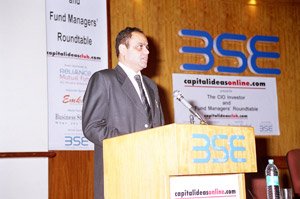
It
is a pleasant duty for me to hand over the
remaining part of the evening to the wizard
behind the wizards of
Rameshji
has been a member of the Bombay Stock Exchange
for over a decade and a half. He is probably the
most listened to financial commentator. He is
one of the
Ramesh Damani:
To start the discussion we turn to the king of
the panel first – so I’ll start with you,
Rakesh, as always. Well, what do you think of
the market?
|
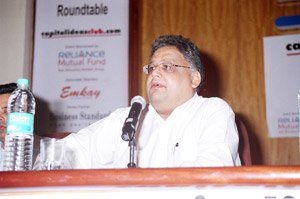
Rakesh Jhunjhunwala: The bullish market is not the index, it is the bullishness of the Indian economy. And as long as don’t come to a conclusion that
|
Although
you could have the economy growing but you could
have very high interest rates which is a big
factor in the valuation of the market. That
could temporarily disturb the market.
As
long as
Ramesh Damani: Sometime they say stock prices are slave to corporate profits over the long term. What is your outlook for corporate profits or the Sensex in 2007?
Rakesh Jhunjhunwala:
Well, to be very frank, I don’t do too much
mathematical research. I don’t say that
But I do believe
that you have the biggest market and the biggest
opportunity for all companies is the economy.
Look at any sector, everything is at such an
early stage of growth.
Ramesh Damani:
I
now have a question for you. We have had four
years of solid gains in the Sensex. Do you make
it five years in a row for 2007?
Rakesh Jhunjhunwala:
Well,
seeing the apprehensions that people have, I
don’t see any reason why it shouldn’t be.
Because if you have 15 to 18 per cent earnings
growth, unless P/Es dip or those earnings dip, I
don’t see any reason why there should not be a
positive year.
Ramesh Damani:
Sanjoy, in the 2006 roundtable, you had said
that
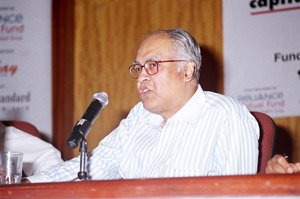
Sanjoy
Bhattacharya:
I got it wrong the previous year. Clearly, I
missed the way the economy would respond to a
number of different stimuli – whether it was
policy driven or liquidity driven – and many of
those remain in place. To not have learned from
that would be a tremendous sin.
Much of
what has transpired in the past 12 months is
indicative as Rakesh said of a turning point for
this nation’s economy.
This
market bears a burden of very high expectations.
And the way people are pricing future earnings
suggests that, the penalty for getting that
wrong will actually be quite serious.
I
don’t doubt that if you have an economy growing
at 14-15 per cent in nominal terms and you have
certain advantages which are there to stay and
which are long term in nature, things are
improving. That is a clear indication that
things are getting better. That can only help
productivity.
Ramesh Damani:
And margins then?
Sanjoy Bhattacharya:
Margins are a function of where you are. I mean
clearly in manufacturing margins are driven by
factors which are not solely in the control of
our economy.
Today
we are much more open as an economy. There is
much less tariff protection; much more global
impact of commodity prices. So you are not able
to insulate yourself from them and as we speak
today, a lot of these things suggest that
margins will be under pressure.
Ramesh Damani:
If you were to say outlook for 2007 in terms of
the Sensex, would you say it would be a negative
year?
Sanjoy Bhattacharya:
I do think though that 2007 will not have the
kind of returns we have seen in the last four
years. We will not see 30-40 per cent plus type
returns spread. The last four years actually
have seen the index multiplying 4 1/2 times.
Ramesh Damani:
Raamdeo, you started this great
Now you’re seeing the tightening–prime rates are going up, housing rates are going up. Can that then stop all or even finish this bull market because interest rates are now swinging from low to extremely high?
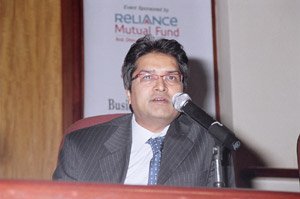
Raamdeo
Agarwal:
This is the first globalised bull run in every
asset class all over the world. The world
economy is struggling to figure out all this
noise about inflation, and only time will tell
because there is no dearth of money.
The
government is worried about the response to
inflation and is saying the rate will fall in
April. But the issue is that it is responding by
closing down exports. So what happens is when
sugar export was possible, you banned it. You
got the inflation under control but what
happened? It has shattered the entire sugar
community.
Ramesh Damani:
Raamdeo, what are your (Motilal Oswal’s)
forecasts for 2007 Sensex earnings?
Raamdeo Agrawal:
By the last count when this quarterly results
got completed, our team had an EPS of Rs 710 for
FY07 and more like Rs 840-845 for FY08 for the
Sensex stocks.
Ramesh Damani:
Madhu, Jim Rogers says that there is a 20-year
bull market for commodities. But yet commodities
sold off quite sharply recently. If you see,
oils, zinc, copper have all sold off. What is
your view on the commodities price going ahead?
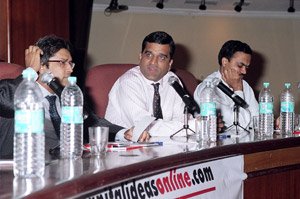
Madhu Kela:
See, I am not a commodity expert. But however
you see there are pockets of commodities which
will do well. Soft commodities in the world
would do well.
Things like food grains
which have not seen any price – real rise in the
world – will do well. But, I am truly scared
when I look at let’s say something like zinc.
You know on a five-year perspective is there a
possibility that zinc prices can be stable at
$3000-3500 a tonne while your cost of production
is $500-600 for an efficient player? So these
commodity prices which have really hit a
significant high from their lows may not
sustain. But that does not mean you will have
bearishness across the board in commodities.
Ramesh Damani:
Madhu, you have been one of the most successful
stock pickers. Any particular themes that you
think will work in 2007? In 2006, Madhu had come
here and had said the thing to attract is real
estate. What do you think of real estate now?
Madhu Kela:
I am certainly not as gung-ho as I was last
year. And in my wildest of imaginations, I also
didn’t expect that stocks will go 100 times in a
matter of a year. So, having said that, I don’t
think you can completely ignore this sector
because this is where 30-40 crore Indians are
interested. Land and property would always be an
interest to
Ramesh Damani:
Tell us how the Sensex will end this year, plus
or minus?
Madhu Kela:
I am positive in a longer run. Making money is
going to be tough if I take a 12-18 or even 24
months period. There are not companies which are
available at 5 or 10 P/E multiples. However, we
have had 50 years of under-valuation in
Ramesh Damani:
Prashant,
how seriously should investors view the threat
of inflation and what do you tell your investors
and how do you protect your portfolio in this
case?
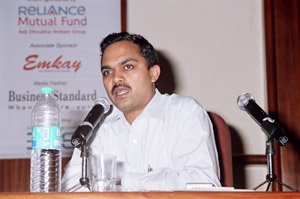
Prashant
Jain:
Real
inflation is actually much more than probably
what the numbers are suggesting. The largest
component in any household expenditure is a
house and houses are clearly unaffordable by
whichever measure you see. If you look at the
inflationary impact on the total consumption
expenditure of the household, inflation is way
in excess of what these numbers suggest.
Banks are offering 10-11 per cent on
deposits, and as we go into March they may start
offering 12 per cent. So over long periods of
time, there is certainly a strong case to be
made that exposure to equities in Indian
households which is very low should increase
significantly but I don’t know at what pace it
will happen – given the fact that fixed maturity
plans from mutual funds offer virtually safe 10
per cent return, which used to be 5-6 per cent
two-three years back.
Economic
growth will still accelerate, but profit growth
will slow down. Profit growth will be lower in
2008 than the profit growth in 2007, and 2009
will be even lower.
Ramesh
Damani:
Does
Raamdeo’s Sensex earnings target of Rs 840-845
seem too optimistic to you?
Prashant Jain:
Yes.
I don’t look at the Sensex as one composite.
In
fact, Sensex has two parts to it–the secular
growth companies which would be companies like
telecom, IT, consumer goods and the cyclicals.
If you split the Sensex into these two parts,
you will get a more realistic picture of the
valuations. And it is not very good. If you look
at the secular growth companies they are all
trading at close to 20 times FY09 earnings – two
years forward, which is not cheap.
And
there are risks – telecom will certainly slow
down by then. You cannot have 100 crore mobiles
in
Cyclical growth companies are trading significantly above replacement cost and we are somewhere close to a peak cycle. So how the sectors will pan out, how zinc, lead, aluminium and steel prices behave, how the margins behave is very hard to forecast. One thing is clear that these are economically unsustainable prices and these profits are not likely to sustain for long time.
Ramesh Damani:
Anoop, what is your outlook for the market? Are
you more cautious or optimistic?
Anoop
Bhaskar:
Last
year has been quite camouflaged. If you look at
the large-caps, there are only six or seven
stocks which have contributed to the entire
movement of the markets.
In terms of
small-caps, we have been in a bear market for
the last 15-18 months. So, it is only six stocks
which have made this whole audience come out
here and say that we are still in a bull market.
The bull market has stopped around 12-15 months
back, frankly.
People
with only small-caps and mid-caps in their
portfolios would have only gained about 8-12 per
cent in the last eight months, which is not a
bull market. I think we’re taking a breather.
With
interest rates being where they are, a rational
investor would take a three-month deposit paying
about 9.5-10 per cent. So, people should invest
in debt rather than equity with such returns
from the markets.
In
equity it is more like a marathon–you cannot run
a sprint all the time. This is the point where
you conserve your energy for the next 12-18
months and make sure that you conserve your
capital for the next round. You cannot keep on
running a 100-metre sprint for the next 20 years
for sure. There are times when…
Ramesh Damani:
…you got to move to debt or the like. Having
said that, for the record, I think everyone
knows the answer, but what would 2007 end for
the Sensex, plus or minus?
Anoop Bhaskar:
It
will depend a lot on liquidity because what
really matters today is not value, it’s only
liquidity. I think the Sensex will be down
between 7-10 per cent.
Ramesh Damani:
In
the first part, we surveyed the forest. Now we
take a look at the trees. How do you turn the
big picture view about the economy, interest
rates, equity markets into winning stocks? There
is, of course lies the essence of successful
investing. The panelists have a vested
interest in the recommendations they are making.
Moreover the panelists may change their views on
the stock recommendation at any point and
therefore investors are requested to do their
own homework before acting on this advice. I
will start with my favourite stock-picker, Bhattacharya… I would like to see three good
stock ideas from you, for one year or three
years…
Sanjoy Bhattacharya:
Tata Elxsi, Grindwell Norton and Rane (
Second,
the valuations still remain very attractive.
This year it will earn Rs 16 per share. If you
leave out the fact that it has had a difficult
and troubled past, its earnings power relative
to capital that it is employing is very
impressive, a reasonably impressive management
team and the growth is definitely sustainable.
Ramesh Damani:
And
a merger with TCS on cards?
Sanjoy Bhattacharya:
That
would be a cherry on the top. I need not worry
about that at all, even if it does not merge
with TCS. Next one, Rane (
Fortunately,
in the Indian passenger vehicles, tractors, LCV
business, a very large proportion of vehicles
manufactured in these categories have manual
steerings. So, growth is assured. Second, it has
a very strong dominant competitive position with
only two serious competitors – Sona Koyo and ZF
Steering, and the record of all three suggests
that the industry as a whole is doing very well.
Third, it has been through a major financial
restructuring. So, you will see a dramatic
change in terms of the efficiency with which
capital is utilized to prepare and grow for the
future. And in exports, it has a link with TRW,
a major global player.
Hopefully we will see Rs
100 crore exports in this to TRW by the year
2009 which will actually change the operating
margin profile of Rane (
It
is cheap, it is going to earn about Rs 11.50 a
share and it will continue to grow at 20-25 per
cent for the next three years. Reasonably
competent, trading at 8 times this year’s
earnings, you should be all right.
Grindwell
Norton is a quasi player at the middle of the
abrasives market, with only two other big
players: at the bottom is Orient Abrasives and
Carborundum is the other one at the high end
with coated abrasives.
With
the industry growing at 9-10 per cent, an
abrasive is like a consumable. To that extent,
demand is assured, no hiccups.
The
interesting thing is that Grindwell has managed
to become far more efficient on the working
capital front, sales growth has been 12-15 per
cent and the company is now moving into higher
and higher value added products as it has
consolidated market share at the bottom end. So,
there is a scope for increasing profitability
with virtually no incremental capital employed.
Other
names that I like are as follows: EIH Associated
Hotels, which has gone through a major
transformation. Another company called Steelcast
and the third one is a company called Amara Raja
Batteries.
All are on the same theme: cheap, sustainable earning power, volume growth, well managed. Oh, and one more company, ABC Bearings which has margins higher than the industry leaders. It is growing and it is very cheap at 8 times this year’s earnings.
Ramesh
Damani:
Raamdeo,
what ideas do you bring for us?
Raamdeo Agrawal:
I
prefer business leaders – globally competitive
and somewhat unpopular. One is Tata Steel. In
1994, it was struggling with half a million
tonne and see the transformation of its balance
sheet in the last 12 years. Although it is a
cyclical business, this is one company that can
execute, has competence, passion and trained
people who understand steel like nobody else
does.
The opportunity to make money in steel is going to be huge in the next five-ten years. I am not happy with the price it has paid for Corus, but one thing can happen. Corus’ average price is about $950 whereas that of Tata Steel is about $550.
The opportunity is that Tata Steel will borrow the technology and competence from Corus to bring up its entire 10-12 million tonne steel to fetch $900 average. And Corus doesn’t know how to operate blast furnaces.
They
pour hot metal at $450. These guys will supply
them the technology to bring it down to $150.
That is what should pan out. Whether it will or
not, at this price you cannot lose much. If it
happens, then this should give a very good
return.
Second
leader in its own category is Glaxo. It has under performed
the market in the past year. The
reason is twofold: its earnings didn’t grow much
and valuations were pretty stretched at the
beginning of the year.
But
in 2008 there are 3-4 patented products which
are going to be launched globally from Glaxo’s
portfolio and they will be launched
simultaneously in
The patent law is in place, the products are being launched and it has a very good, transparent management. Of course, it is not a momentum driven stock, one cannot predict whether in six months one can make money or not.
Ramesh
Damani:
Any mid-cap, small-cap ideas?
Raamdeo Agrawal:
One idea, a mid-cap called
Dena Bank. A Rs 1,000-crore bank, it dominates
half of
Ramesh
Damani:
Madhu, last year you whispered
‘real estate’ in our ears. What are the themes
or sectors and what are the magic words you
would whisper today?
Madhu Kela:
I would like to mention the
contract research and manufacturing theme out of
Multinational
companies annually spend something like $45
billion on research and another $45 billion is
spent on manufacturing of pharmaceutical
products. So, this is one very interesting
opportunity which over the next three to five
years will pan out very well for
Ramesh
Damani:
Madhu you’ve also been invested
in media companies. Can you shed some light on
the prospects for the media group?
Madhu Kela:
In the media business the biggest
thing that will work in its favour is the entry
barrier, which is humongous across the board.
Like in newspapers, you only have 80 per cent of
the advertisements in the top newspaper, 15 per
cent in the second one and the remaining 5 per
cent in the next twenty. The second thing is,
when convergence really happens, content will be
the true king.
Ramesh
Damani:
… and the low advertisement
rates in India have to go up over a period of
time, so that represents the opportunity on the
balance sheet side. Anoop, give us some ideas.
Mid-cap space is something which the retail
investor is always enthusiastic about.
Anoop Bhaskar:
There
are two broad ideas I would like to share. We
produce roughly around 220-odd million tonne of
food grain, which we have to take it to around
340-350 million tonne in the next five-seven
years, because of our population.
Plus,
if you have more income, you’re going to consume
better than in the past. And in the last seven
years there has been no
Another
idea is lubricants, a market in which the
pricing is not controlled by the government and
where the government companies are as ready as
the private sector to raise prices. For the last
12 months, the prices of lubricants have moved
up by almost 37 per cent. And this is one
segment when over the next two-three years, lube
oil refineries around
Therefore,
the price of lube oil could actually move
totally opposite to that of crude oil. Because
there would be so much of supply and the pricing
of the final product is not controlled by the
government.
These
are companies which have some brands. If they
are able to keep a part of the fall in lube oil
prices, then the jump in profits of these
companies would be very high.
Ramesh Damani:
Prashant,
you won’t bet on stocks but tell us some themes
at least.
Prashant Jain:
I
think auto components. If
And
there are signs that
Ramesh Damani:
…
make up for the losses.
Prashant Jain:
Yes.
So the downside becomes limited. They are
available at book values, and the book values
are fraction of the replacement costs. So, I
think there’s some value. If oil prices fall,
the upside could be very fast and very
significant. But clearly there is no momentum
and it is an out of favour sector, so one has to
be patient. They also have good earnings yields.
Ramesh Damani:
Let’s
hear the stock picks from the best stock-picker
in
Rakesh
Jhunjhunwala:
I
agree with Raamdeo, that Tata Steel could be an
extremely good long term investment over a
three-five year horizon. The steel industry has
changed.
The
approach to the steel industry has changed from
one of government approach to one of profit.
Second, when people say that Tata Steel’s
acquisition of Corus is a bull market excess,
what bull market is Tata Steel in when it is
valued at 6 times earnings, and pre-tax 5 times?
Tata
Steel will make iron ore intensive products and
sell it to Corus. Plus, Corus can add 4 million
tonne finishing capacity without much
investment, which can be utilized with the same
labour force. Tata Steel itself is going from 10
million to 12 million tonne.
Mr. Muthuraman has said that the combined EBITDA
margin will be 25-30 per cent. If you look at Rs
100,000 crore of sales, at 25 per cent EBITDA
margin, it’s Rs 25,000 crore. Tata Steel’s
equity is not going to exceed Rs 750 crore, even
after an issue. And then you look at it, they
are financing it perfectly.
Tata
Steel has $1 billion cash, $2 billion equity
will come – they put that into an SPV. That SPV
will borrow $1 billion which may have recourse
to Tata Steel and that money will be invested in
Corus. Corus will take debt, which will not have
any recourse to Tata Steel. So, Tata Steel is
not really risking anything except that $1
billion, which is 6-7 month cash flow for the
company. And if they succeed at what they’re
saying, a 750 crore equity can produce Rs 25,000
crore EBITDA.
My
second investment is Titan. It’s a very
expensive stock, but there are certain companies
which will produce dominance, and when they will
be in their youth, they will produce huge cash
flows. So I believe Titan can be one such
company. It’s for a patient investor and
investing in it is fraught with risk.
The
third stock is Bilcare, and again this is for a
patient investor for three-five years. If
Bilcare is successful in doing what it has set
out to do, it will be among the top companies of
the world in the pharmaceutical package. It will
have a fully diluted equity of about Rs 21 crore
and this year it will earn about 50 crore.
It’s
not cheap at about 20 times its earnings. It has
invested in facilities in
Ramesh Damani:
There’s
a very nice philosopher, who’s an existentialist
– Albert Camus and he wrote a very nice thing,
which is a great way to conclude this
discussion.
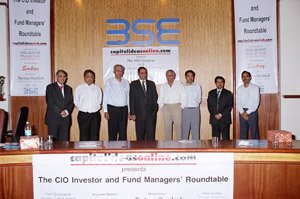
He said you’re forgiven for your happiness and success only if you generously consent to share them. I want to thank my panelists by sharing the joy and wisdom of investing generously with all of us today.
Courtesy:- Capitalideasonline.com